Showing posts with label apitherapy. Show all posts

Thursday, 24 March 2016

Let’s Get to the Point … Stingers

 
Foraging honey bee in alfalfa


When you mention honey bees, the first two things people usually think of are honey and stings. One incredibly sweet, the other … not so much!

It is certainly true that if you see a honey bee working, it is best to leave well enough alone. A foraging bee’s sole focus is to collect as much nectar and pollen as possible. Stinging is a defense mechanism and used only as a last resort to defend herself or her hive.


Honey bees that sting ... and those that don't


The queen bee
Queen honey bee

The queen bee can sting. She has a smooth, slightly curved stinger and she can sting repeatedly. The chances of you getting stung by a queen bee are pretty close to nil. She saves her venom for her queen rivals. Once she has established that she is sole queen of the hive she can no longer sting at all.


If you find a queen bee (again not likely unless you’re looking inside a hive) she’s pretty defenseless. But believe me, there are numerous other bees there to do the job!
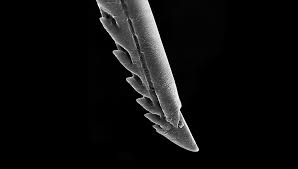

The worker bee

Magnified tip of a worker bee stinger

It’s the worker bee that defends the queen and the hive. With a sharp, barbed stinger, she’s well equipped to do the job. Once she stings she will fly away leaving her stinger, poison sack, and muscles from her abdomen to pump the poison in.


The drone


Well, those lazy drones live up to all expectations. They don’t sting. They aren’t even equipped with stingers! They maintain their reputation as the cute, friendly honey bees!


What happens to you after a sting


Removing a honey bee stinger

The first order of business is to remove the stinger. The best plan of action is to scrape the stinger out with a fingernail, credit card, etc. What you don’t want to do is pinch the poison sack and inject more venom. Once the stinger has been removed ice and a topical ‘bug bite’ ointment can be applied. Old time beekeepers have been known to hold a penny (remember those??) on a sting to reduce pain and swelling.


Reactions to bee stings can range from a slight tender spot to full anaphylactic shock which can result in death. Someone who has been stung should be monitored for ANY symptoms that indicate an allergic reaction, and appropriate measures taken.


What happens to the worker bee after a sting

Worker bee after stinging


After stinging, her life is over. She can live up to an hour before dying. As you can imagine, stinging is not something she wants to do, but she will not hesitate to give her life in defense of her hive, or herself.


If you accidentally put your hand down on a honey bee, she will give you a ‘buzzing’ warning. As long as you haven’t squished her too badly, she’s usually happy to just get away!


Benefits of bee venom


Believe or not, there most definitely are benefits to bee venom. If you happen to have arthritis, and just happen to get stung by a honey bee … you might just want to leave that stinger in. Bee venom is known to relieve the symptoms and pain of arthritis and studies are being done on bee venom and MS.


Chances of being stung


The actual chances of being stung by a honey bee are pretty slim. Most stings happen when someone steps on, sits on or accidentally squishes a honey bee. If by chance a foraging bee decides to visit you, it is best to not try to brush her off (sometimes hard in that panic mode!!) but blow or shake her off.


Mistaken identity


You are much more likely to be bit or stung by a wasp, yellow jacket or hornet. These insects are quite aggressive unlike our peace-loving honey bees!

 
Worker honey bee
Wasp

Friday, 18 March 2016

Propolis - Nature's Antibiotic

Propolis

During cold and flu season everyone seems to have their own magical cure ... and I am no different! Mine, of course, comes from the hive. The minute someone sneezes or coughs I am very quick to recommend, and usually share, my no fail cure, propolis!!

Most people know that bees collect nectar and pollen (or they should if they're reading my blog!!) Honey bees also collect resin from trees. Preferably conifer and poplar trees. This is carried back to the hive on her back legs, just like pollen. This resin is mixed with a little bit of wax and water and becomes an incredibly sticky product called propolis.


Propolis in the hive


Propolis in the hive

Those innovative honey bees have thought of everything, including an all-purpose antibiotic, antiseptic, antifungal, and antiviral substance. With up to 60,000 individual honey bees in one hive, it's important to maintain a clean environment. 


If that isn't amazing enough, propolis is also the perfect compound to seal and water-proof the bee hive! A drafty location does not present a problem. Propolis production goes into high gear and every crack and hole is sealed with this multipurpose 'bee glue.' This effectively weather-proofs a hive. When you see bee boxes stacked, you can be assured each box is securely 'glued' to the one above and below with a generous amount of propolis.

Every cell in the hive is polished with propolis. A queen bee will inspect each cell for cleanliness before she's willing to lay a precious egg in it. Honey cells are also sterilized with propolis.


Propolis for beekeepers


For beekeepers working in the hives, propolis is a bit of a nuisance. It is very sticky, and pulling boxes, or supers, apart to check hives requires special tools to break the propolis seal. Although, a hive full of propolis is generally going to be a healthy hive!


Propolis for all of us


Honey bees use propolis to sterilize their hive, we use it as a natural antibiotic. Unlike honey, propolis is not sweet and does not taste good. Even so, millions of people continue to take it in its various forms.


Propolis in capsule form

Capsules. Probably the easiest form to take. This convenient way allows you to enjoy all the benefits, without the nasty taste.


Propolis in spray form

Liquid spray. This direct application method is most effective for sore throats, sores in the mouth or dental/gum issues. There is the unpleasant taste factor, but the effectiveness makes it well worthwhile. In this form, propolis should be in everybody's first aid kit. It is amazing for disinfecting and healing cuts, abrasions and also bug bites/stings.


Tincture. For children and people who can't swallow capsules, this is a nice option. A few drops can be added to a small glass of juice, usually masking the taste. Propolis is highly recommended in this form for topical application.


Propolis in powder form

Powder. This versatile option is the most potent and can be added to other applications. It is often included in soaps, creams and ointments, or mixed with a little bit and honey for a stronger dose.


Propolis as a medical treatment


Kills bacteria
Treat asthma
Prevents cavities
Anticancer activity
Reduces heat stress
Treatment for warts
Treat food poisoning
Lowers blood pressure
Treat seasonal allergies
Anti-inflammatory effects
Promotes athletic performance
Reduces fat and cholesterol levels
Protects against cell phone radiation
Helps build and maintain healthy bone tissue


Propolis and general health

I like to take one or two propolis capsules daily to maintain a healthy immune system. If I think I might be getting sick, I simply up the dose!


In the past, studies on beekeepers have shown they tend to be one of the healthiest, long-living groups of people. It was discovered, that while they tend to sell most of the honey their hives produce, they were eating the 'hive droppings' which consist mainly of propolis and bee pollen. Today, these 'hive droppings' are purposefully collected and shared with the rest of the population. Interesting!!


This is just another amazing product that is so good for us from that most amazing creature, the honey bee.


Propolis