Showing posts with label dandelion. Show all posts

Friday, 10 June 2016

Weed Control for Beekeepers


Indea in my field of dandelions


Beekeeping is full of conundrums, and trying to maintain an all-natural yard without having your neighbors completely hate you is definitely one of them. I have been fortunate that no one has complained (yet) about my beautiful crop of dandelions!


I too, can appreciate a nice yard and control over the non-flowering, non-nectar producing weeds. At the moment, my yard has an over-abundance of these less desirable plants. My first plan of attack was to pull out, by the roots, these non-contributing intruders. But after the first couple hours, having hardly made a dent, I decided to search for other options.


Roundup weed killer


You don’t have to look much farther than your local hardware store or garden center to find a quick and easy solution. I’m sure nobody has missed the negative hype that surrounds this popular product. Not only is it extremely harmful to honey bees and other pollinators, it’s been proven to not be too healthy for us either … but that’s for another blog.


So, what to do? I had read about a recipe that is ‘guaranteed to kill weeds’. It sounded simple enough. I thought I’d give it a try and aim for an only-the-weeds-I-want type yard.


A fabulous invention!


I bought a pressurized sprayer as my yard is too overrun for a handheld spray bottle to do the trick. This is an absolute must and I can’t believe I have never owned one before!


The recipe calls for four liters of plain white vinegar. If vinegar is such an effective weed killer … should I really be putting it in my beets to make pickles?? Something for future pondering …


Two cups of Epsom Salt was the next ingredient. Epsom Salt is good for just about everything; why not weed killing as well!


And finally, a half cup of ‘blue’ Dawn dish soap. Not sure what’s in this, but it shows up a lot in ‘deep cleaning’ recipes.


With my weed killer mixed, the pressure sprayer filled and pressurized, I headed out to do battle with the weeds invading my wooden walkways and flowerbeds.


This was the result only four hours later! The weeds are looking dry and turning brown. I’m very happy with the results and can’t wait to mix another batch and continue on.


With this effective recipe, I don’t have to live with unwanted, invasive weeds, nor do I have to spray with harsh chemicals that hurt/kill pollinators, can make my dog sick, and are harmful to the environment and me. I can rest assured I’m not harming the pollinators that visit my yard and the honey bees that live here are not being poisoned by the very food they eat. (Something we all need to think about.)


Butterfly sipping nectar on a dandelion


This is the hive in my yard. I checked it yesterday to find a very productive queen bee at work. The population is still low, but considering the trauma they endured, they’re doing quite well. You can still see the muddy bear paw print on the bottom box.

Honey bee hive that survived the bear attack

Friday, 3 June 2016

Dancing Bees


It isn’t a salsa, samba, tango or waltz, but is just as intricate. This dance is performed repeated throughout the day in honey bees hives around the world.


The above video shows a worker who has recently returned from a foraging trip. By the color of the pollen on her back legs, she’s pretty excited about the patch of dandelions she found. Her job now, as a dancer, is to give explicit directions to this choice site. As you can see in the video, she has a few interested foragers.


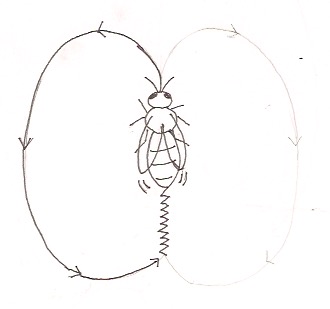
The basic waggle dance pattern follows a figure-eight circuit.


Left half of waggle dance


Our dancing bee starts by ‘waggling’ her abdomen back and forth and back and forth as she runs forward. At the end of her ‘run’ she will walk around to the left and begin the dance all over again.


Right half of waggle dance


She will ‘run’ again in the same direction waggling her abdomen for the same amount of time. At the end of this ‘run’ she will turn to the right and complete the figure-eight pattern.


To keep her followers interested, she may stop briefly to share some of the nectar she has collected. This way her sisters know what type of flower they are looking for.


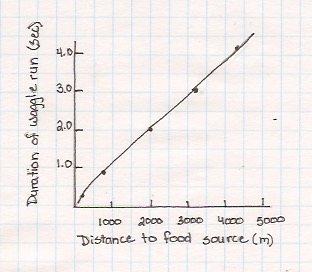
Duration to distance of waggle dances

Believe it or not, extensive studies have been done on deciphering the waggle dance. Basically, the duration of the dance indicates the distance from the hive to the luscious source of nectar/pollen. Roughly one second of waggling equals 1000 meters.


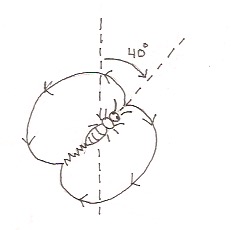
The direction and length of the waggling (which will always be the same for the duration of the dance) gives the exact location of the flowers in relationship to the sun. Sounds complicated? It is.


Fortunately, honey bees are much better at geometry than I am!


Forty degree waggle dance

The angle that she waggles, as opposed to going straight up, is directly related to the angle of the sun in relation to the nectar/pollen source. The worker in the video is on about a 135 degree angle.


Honey bee navigation

The other foraging bees learn the dance and know exactly where they’re headed when they leave the hive. The final key to finding that amazing patch of flowers is scent.  This they would have picked up from sampling nectar from the bee doing the initial dance. Recruited foragers make a bee-line from the hive to the nectar/pollen source.


So much for thinking how brilliant we are with our GPS. Honey bees have been pin-pointing locations for thousands of years!


Foraging honey bee in alfalfa


Thursday, 12 May 2016

Bee Whyld Yukon Update

Four spring bee hives


Dandelion

Spring Crocuses


It’s spring!! The dandelions have been out for a couple weeks now, and just last week we came across a number of my favorite flowers, crocuses!! Bees love both of these early flowers!!


In a beekeeper’s world, spring is a busy time. Before too much is actually done with the bees, there is a little time to build/repair boxes, frames and other equipment for the busy honey-producing season to come. This is exactly what’s been happening at Bee Whyld.


New Equipment


Unpacking the new extractor


It’s pretty exciting when new equipment arrives. This year it is in the form of an electric, 20-frame extractor, or honey spinner! Everyone who experienced last year’s harvest with our little two-frame hand spinner can dearly appreciation the huge contribution this piece of equipment will make to this year’s, hopefully much larger, harvest!


Preparation for Our New Bee Hives


The designer and carpenter
End of the day

With the arrival of 60 new hives scheduled for later this month, the Bee Whyld Team (including the recruitment of a couple friends – thank you Leatha and Emily) has been very busy in the shop building and painting supers (honey boxes).


Assembly line team work


With access to Liz’s bee-keeping expertise from New Zealand, we plan to try our hand at splitting a few of the stronger hives this spring. As a result, additional brood boxes (where the queen lays eggs) were also added to the assembly line.


School Tour


Honey bee presentation in progress


Bee Whyld was honored to spend a day at Johnson Elementary School in Watson Lake, Yukon. The students learned about all the jobs in a beehive, the role of the queen bee, worker bee and drone bee, and the role of the beekeeper. Everyone got to peek in a beehive (minus the bees!) and try his/her hand at running the extractor. And, of course, there was honey to taste. Our delectable, local Fireweed Honey was deemed the favorite and the very different Dandelion Honey received mixed reviews.


Signed by all the students


Sharing our passion of honey bees with six different classes of enthusiastic students made for a fun and fulfilling day.


Candle Making


Candle making is back in full swing. I decided to try some charcoal filtered wax for some white candles. I still think my preference is the more traditional yellow beeswax. With yellow beeswax on order, both yellow and white candles will be available for sale shortly.

Yellow and white beeswax candles


The Bees

Four of our six hives survived the winter. The queens have been busy creating numerous frames of brood. The brood boxes were rotated and a super added last week. Tons of pollen is being carried  in daily, and with the early dandelions, the first honey of 2016 is already in production.